
Inside a PoE Switch Factory: Production Process, Testing & Quality Control Explained
By ANPA Quality Engineering Team
Key Takeaways:
• A PoE switch goes through 12 core production steps from PCB assembly to final packaging
• ANPA employs a four-stage quality control system: IQC (Incoming) → IPQC (In-Process) → FQC (Final) → OQC (Outgoing)
• Every PoE switch undergoes 72-hour burn-in testing before shipment, ensuring MTBF of 50,000 hours
• ANPA factory key metrics: SMT soldering yield >99.5%, outgoing defect rate <0.3%
• B2B buyers can request remote video factory audits or on-site visits to ANPA’s Chaozhou facility
How Is a PoE Switch Made? — A Complete Manufacturing Overview
PoE switch manufacturing is a precision process involving SMT component placement, through-hole insertion, soldering, assembly, testing, burn-in, and packaging. Unlike consumer electronics, PoE switches must simultaneously handle data signal transmission and high-power DC delivery, demanding far more rigorous production processes and quality control standards than typical networking equipment.
As a manufacturer with years of PoE switch production experience, ANPA provides a first-hand factory perspective on the complete journey of a PoE switch — from raw materials to finished product.
From PCB Placement to Shipment: ANPA’s 12-Step Production Process
Phase 1: SMT Surface Mount (Steps 1-3)
| Step | Process | Key Control Points |
|---|---|---|
| Step 1: Solder Paste Printing | Solder paste is precisely printed onto PCB pads through a stencil | Paste thickness, alignment accuracy |
| Step 2: High-Speed Pick & Place | SMT machines place chip components (resistors, capacitors, ICs) onto PCB at high speed | Placement accuracy ±0.03mm, throw rate <0.1% |
| Step 3: Reflow Soldering | PCB passes through a reflow oven; solder paste melts to form reliable joints | Temperature profile control (preheat → soak → reflow → cooling) |
Engineer’s Insight:
SMT is the foundation of PoE switch quality. Soldering defects (cold joints, bridges, insufficient wetting) are the leading cause of field failures. ANPA employs dual inspection at the SMT stage — SPI (Solder Paste Inspection) and AOI (Automated Optical Inspection) — maintaining soldering yield above 99.5%. That means fewer than 5 defective solder joints per 1,000.
Phase 2: Through-Hole Insertion & Wave Soldering (Steps 4-6)
| Step | Process | Key Control Points |
|---|---|---|
| Step 4: Through-Hole Insertion | RJ45 connectors, transformers, power interfaces and other through-hole components are inserted into PCB | Insertion direction, seating verification |
| Step 5: Wave Soldering | PCB passes through wave soldering machine; molten solder joins through-hole leads | Solder temperature 260±5°C, conveyor speed control |
| Step 6: Manual Touch-Up & Inspection | Operators manually solder areas inaccessible to machines and visually inspect joint quality | Joint fullness, luster, no cold solder |
Phase 3: Assembly & Functional Testing (Steps 7-9)
| Step | Process | Key Control Points |
|---|---|---|
| Step 7: PCBA Cleaning & Inspection | Flux residue and contaminants removed; PCBA visual inspection | No residue, no damage |
| Step 8: Full Assembly | PCBA installed into metal/plastic enclosure, internal cables connected, heat sinks mounted | Fastening torque, cable routing |
| Step 9: Functional Test (FCT) | 100% full-function testing: all port connectivity, PoE output power, data rate, VLAN functionality | Pass rate target >99.8% |
Engineer’s Insight:
Step 9’s functional test is what separates ANPA from low-end workshops. Our FCT station tests every port on every PoE switch independently: ① Network connectivity and speed (10/100/1000Mbps); ② PoE output voltage and current (verifying IEEE 802.3af/at/bt compliance); ③ Total power budget validation. Any failure means the entire unit goes back for rework.
Phase 4: Burn-In Testing & Final Inspection (Steps 10-12)
| Step | Process | Key Control Points |
|---|---|---|
| Step 10: Burn-In Test | All PoE ports run at full load in elevated temperature environment for 72 continuous hours | Temperature 45-55°C, output voltage drift monitoring |
| Step 11: Final Inspection (FQC) | Comprehensive re-inspection after burn-in: appearance, functionality, PoE performance | Comparison with Step 9 data, no degradation |
| Step 12: Packaging & OQC | Labeling, accessory kit assembly, box sealing, OQC spot-check | Accessories complete, labels correct, packaging intact |
Four-Stage Quality Control: IQC → IPQC → FQC → OQC
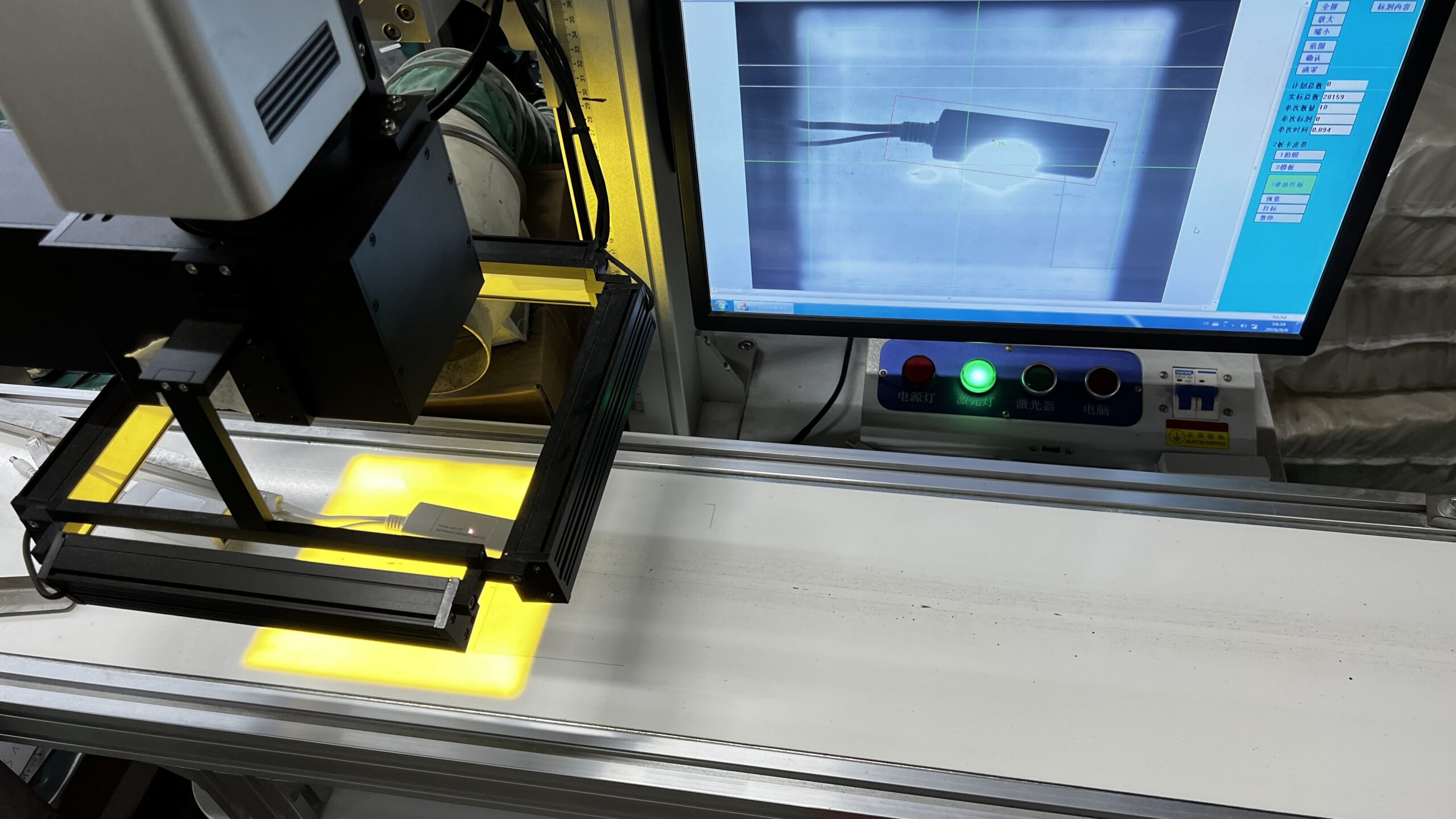
ANPA AOI automated optical inspection system
At ANPA, quality control is not “check it at the end” — it’s “full-process coverage.” Our four-stage QC system ensures every PoE switch leaving the factory meets specification.
Quality Control Stages
| Stage | Name | Timing | Core Activities | Non-Conformance Action |
|---|---|---|---|---|
| IQC | Incoming Quality Control | Before raw material storage | Component parameter sampling, PCB flatness check, enclosure dimensions | Return to supplier |
| IPQC | In-Process Quality Control | During production | SMT solder joint AOI inspection, assembly torque, cable connections | In-line rework |
| FQC | Final Quality Control | After assembly | 100% functional test, post-72-hour-burn-in re-inspection | Full unit rework or scrap |
| OQC | Outgoing Quality Control | After packaging | Visual inspection, accessory verification, label confirmation, sample unboxing | Halt shipment, rework |
Key Quality Metrics
| Metric | ANPA Target | Industry Average |
|---|---|---|
| SMT Soldering Yield | >99.5% | 98%-99% |
| Outgoing Defect Rate | <0.3% | 1%-2% |
| Burn-In Test Coverage | 100% | Some factories only sample |
| Field Return Rate | <0.5% (12 months) | 2%-5% |
Burn-In Testing: Ensuring 50,000-Hour MTBF for Every Switch
What Is Burn-In Testing?
Burn-in testing is the practice of running products continuously under simulated (or more severe) operating conditions before shipment, designed to expose potential early-life failures. It is the most critical reliability verification step in PoE switch manufacturing.
ANPA Burn-In Test Protocol
| Parameter | Specification |
|---|---|
| Duration | 72 hours (3 days) continuous operation |
| Ambient Temperature | 45-55°C (above normal operating temperature) |
| Load Condition | All PoE ports at full load |
| Monitored Parameters | Output voltage stability, output current, chip temperature, packet loss rate |
| Pass Criteria | No functional anomaly within 72 hours, parameter drift <3% |
Manufacturer’s Perspective:
Not all factories perform 100% burn-in testing. Some cut time and electricity costs by sampling only a portion of each batch. ANPA insists that every PoE switch leaving the factory must complete the full 72-hour burn-in test — this is how we keep our field return rate below 0.5%. The short-term cost increase buys us long-term quality reputation. That’s a calculation we’ve made very deliberately.
— ANPA Quality Director
MTBF and Burn-In: The Connection
MTBF (Mean Time Between Failures) is the core reliability metric for PoE switches. ANPA products are rated at 50,000 hours MTBF (approximately 5.7 years of continuous operation). This figure is not arbitrary — it is derived from accelerated life test data using the Arrhenius model, and continuously validated by real-world field performance data.
Factory Tour: Key Production Equipment
| Equipment | Purpose | Impact on Quality |
|---|---|---|
| High-Speed SMT Pick & Place | Precision placement of chip components | Placement accuracy directly affects soldering yield |
| Lead-Free Wave Solder Machine | Through-hole component soldering | Solder temperature stability determines joint reliability |
| AOI Automatic Optical Inspection | Automated SMT defect detection | Replaces manual visual inspection, detection rate >99% |
| 72-Position Burn-In Rack | Batch product burn-in testing | Ensures reliability of every unit |
| Network Analyzer | Data port performance testing | Verifies transmission speed and signal integrity |
| PoE Load Tester | PoE port power accuracy testing | Ensures output power meets IEEE standards |
| Hi-Pot Withstand Voltage Tester | Electrical safety testing | Ensures insulation performance, CE/FCC safety compliance |
Why Factory Transparency Matters for B2B Buyers
In PoE switch procurement, information asymmetry is the biggest risk. B2B buyers cannot assess internal build quality, component grades, or test coverage from external appearance alone. This is why factory transparency is critical.
Transparency Measures You Can Request from ANPA
• ✅ Remote Video Factory Audit: Live video walkthrough of our SMT line, assembly area, and test stations
• ✅ Quality Reports: Complete IQC/IPQC/FQC/OQC inspection records included with every shipment
• ✅ Certification Verification: Original CE/FCC/RoHS certificates provided for verification
• ✅ Sample Teardown: We encourage buyers to disassemble samples and inspect internal build quality
• ✅ On-Site Visit: B2B customers are welcome to schedule an in-person tour of our Chaozhou factory
For more information about ANPA’s factory, visit our About Us page, or contact us to schedule a remote factory audit.
FAQ: PoE Switch Manufacturing — Common Questions
Q1: How long does it take to manufacture one PoE switch?
A: From PCB placement to packaging, a single PoE switch requires approximately 1-2 working days of production time. However, this does not include the 72-hour burn-in test. Total lead time from production start to shipment is 4-5 days for standard orders. Custom orders: simple label customization 3-7 days, custom packaging 15 days, fully new design development approximately 40 days.
Q2: What is ANPA’s monthly PoE switch production capacity?
A: ANPA’s factory operates at a monthly production capacity in the tens of thousands of units, with flexibility to scale based on order demand. For orders exceeding 100,000 units, we develop dedicated production schedules to ensure on-time delivery. For specific capacity data, please contact our sales team.
Q3: How can I arrange a factory visit?
A: International customers can verify our factory through: ① Remote video audit (most convenient, can be arranged within 1-2 days); ② Third-party factory audit (e.g., SGS, Bureau Veritas); ③ On-site visit to our Chaozhou factory (we provide pickup service).
Q4: What is ANPA’s outgoing defect rate?
A: Our outgoing defect rate target is <0.3%, and we consistently maintain it between 0.2%-0.3% over the long term. This is achieved through 100% functional testing and 72-hour burn-in coverage on every unit. Our 12-month field return rate remains below 0.5%.
Q5: What is the MTBF of your PoE switches?
A: ANPA PoE switches are rated at 50,000 hours MTBF (approximately 5.7 years). This data is based on accelerated life testing and Arrhenius model calculations, continuously validated by real-world field performance data.
Conclusion
A high-quality PoE switch is not simply “made” — it is “managed.” Every stage from IQC to OQC demands rigorous discipline. ANPA’s 12-step production process and four-stage quality control system ensure every unit leaving the factory meets the 50,000-hour MTBF standard.
Want to see our factory firsthand? Schedule a remote video audit now →
Related Articles
• [PoE Switch Manufacturer: The Complete B2B Guide to Factory-Direct Purchasing](https://poeswitchmanufacturer.com/blog/poe-switch-manufacturer-factory-direct-guide/)
• PoE Switch Factory Quality Control: From IQC to OQC for Zero-Defect Delivery *(coming soon)*
• Gigabit PoE Switch Manufacturer: ANPA Full Gigabit Product Line Overview *(coming soon)*